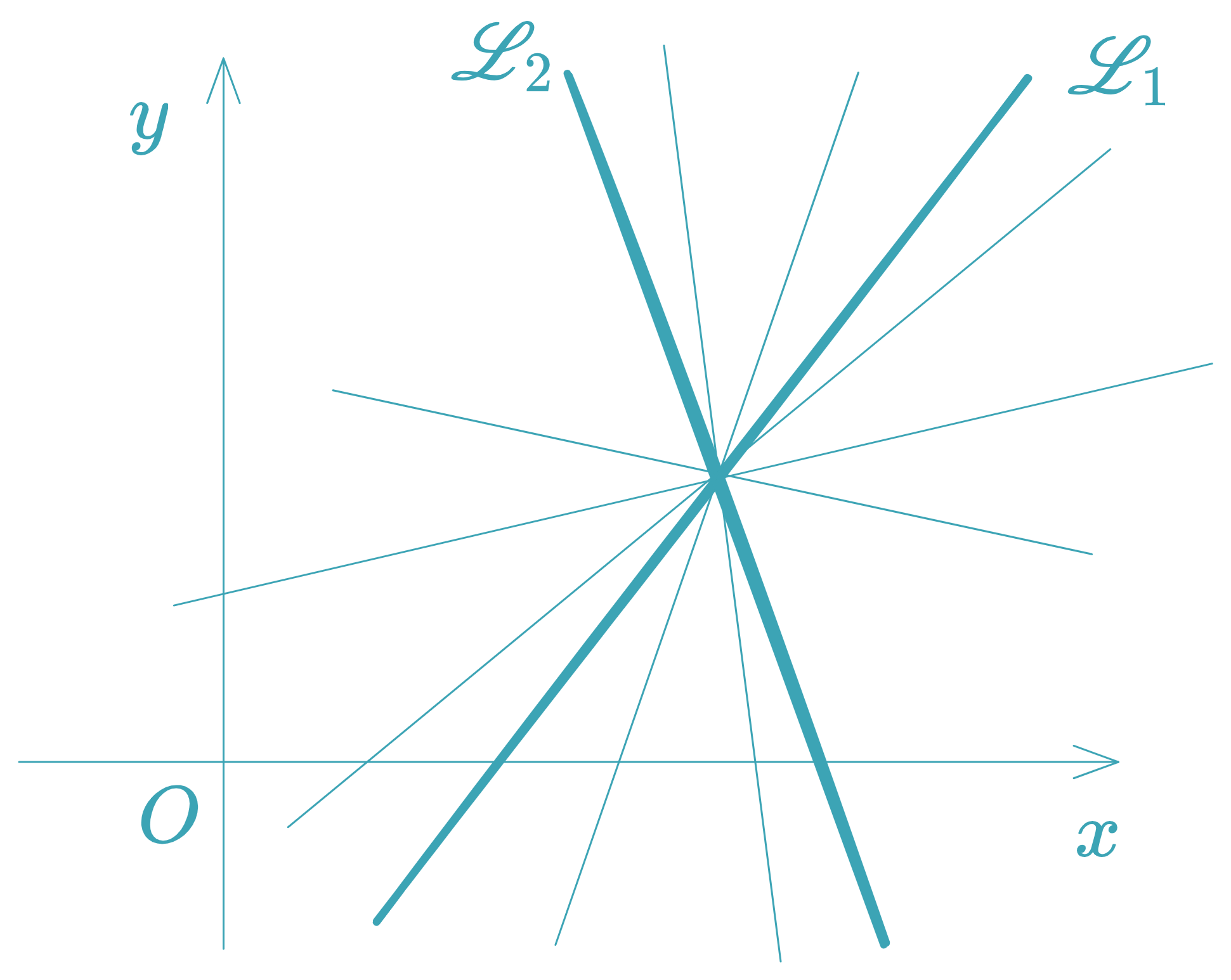
The Straight Line
Definition
A straight line is the locus of all points in the plane that follow a constant direction.
Angle of Inclination
The angle of inclination of a line is the angle measured counterclockwise from the positive -axis to the line, such that .
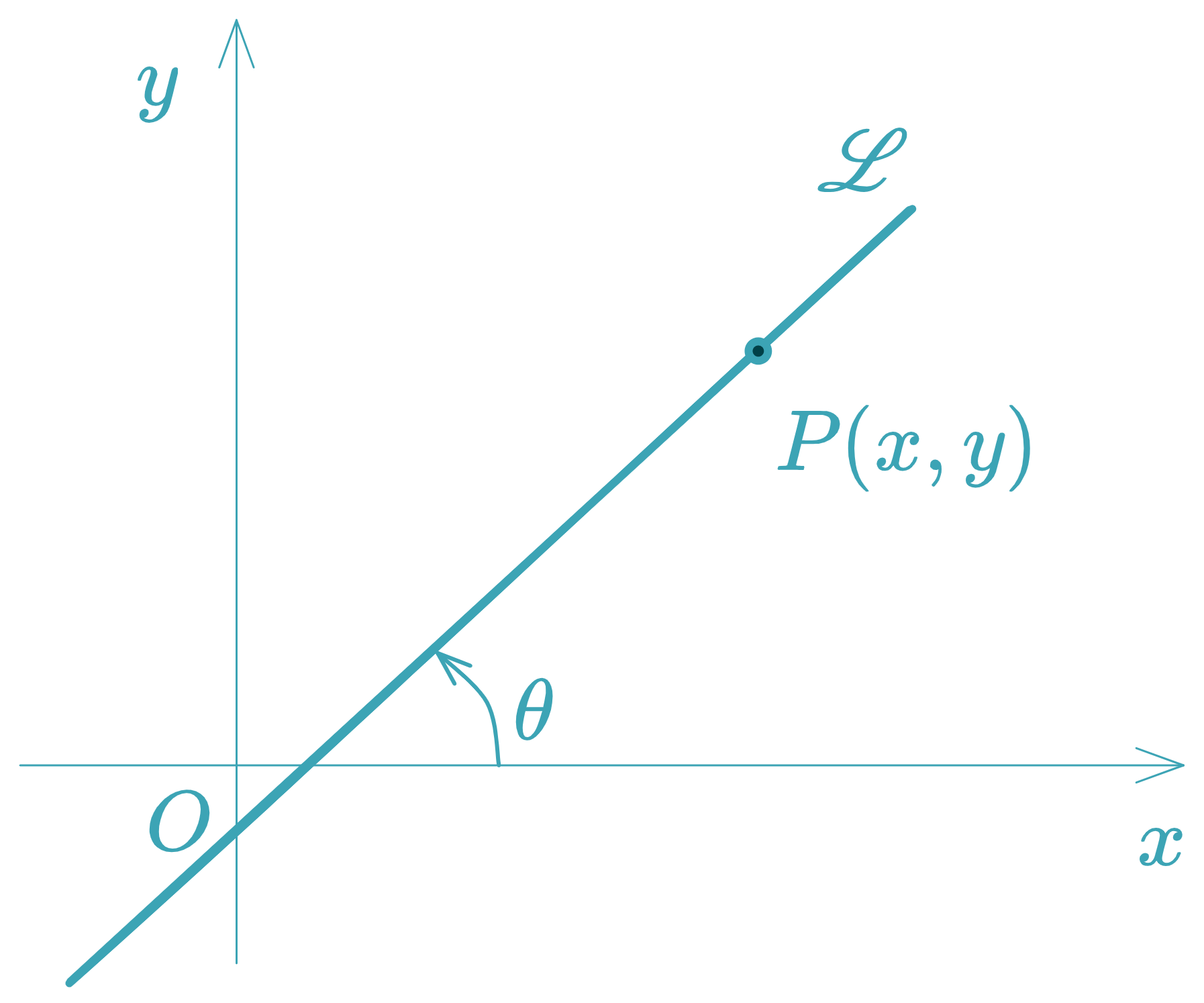
Slope of a Line
The slope of a line is defined as the tangent of its angle of inclination:
Observations:
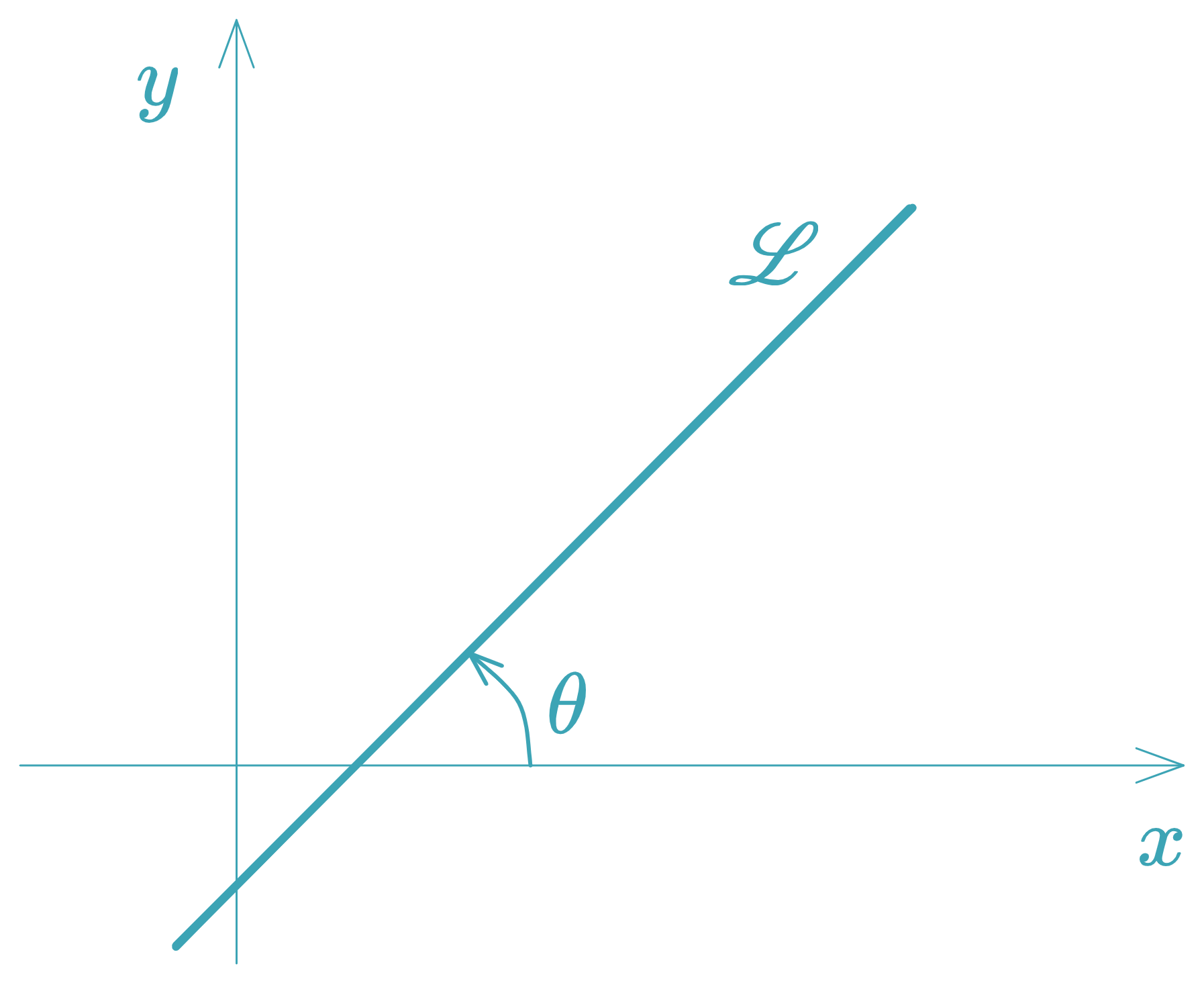
1. If $\theta < 90^\circ$, then $m > 0$ → the line is **increasing**.
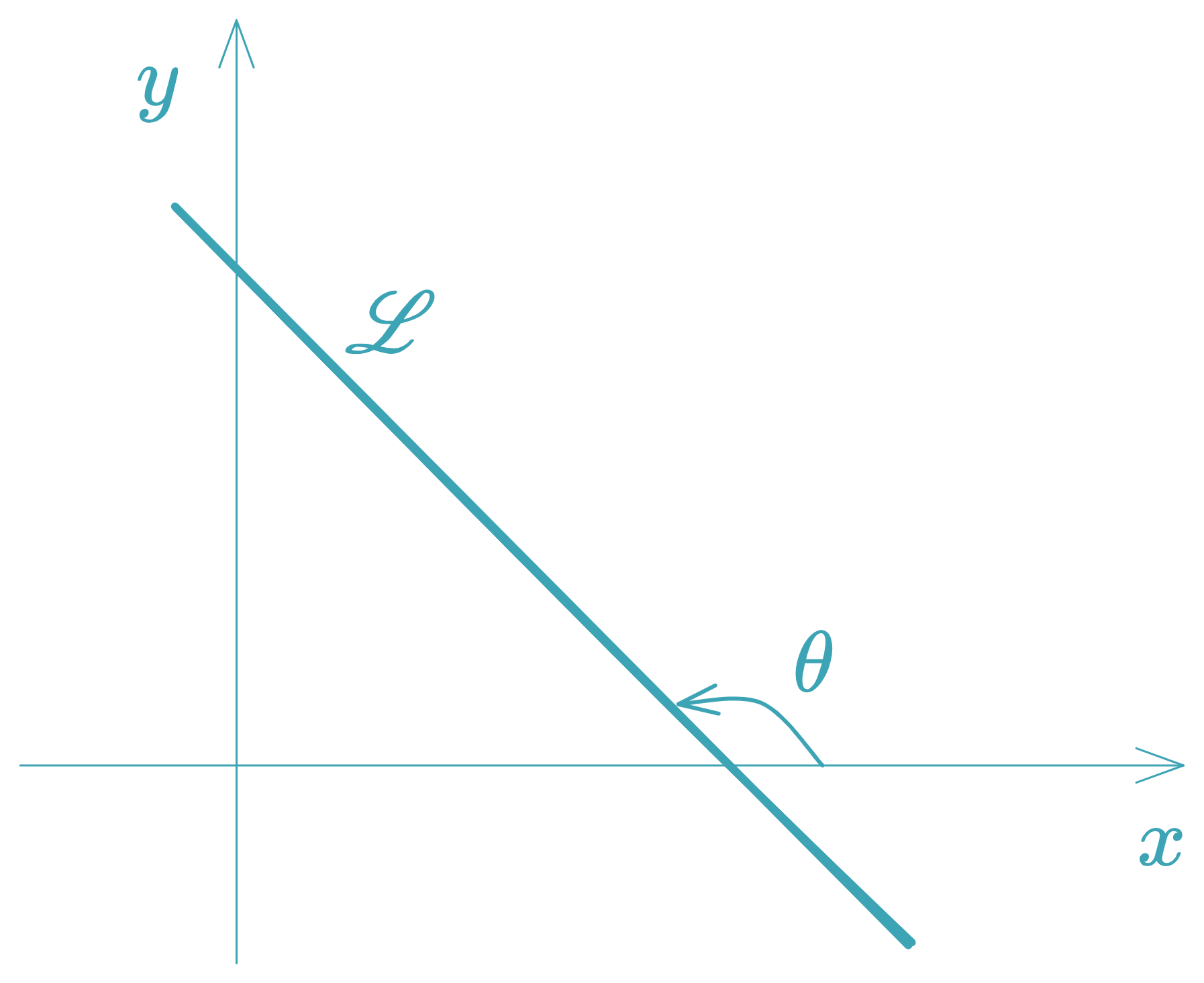
2. If $\theta > 90^\circ$, then $m < 0$ → the line is **decreasing**.
3. If $\theta = 90^\circ$, then $m$ is **undefined** → the line is **vertical**.
Forms of the Equation of a Line
Point-Slope Form
Given a point and a slope :
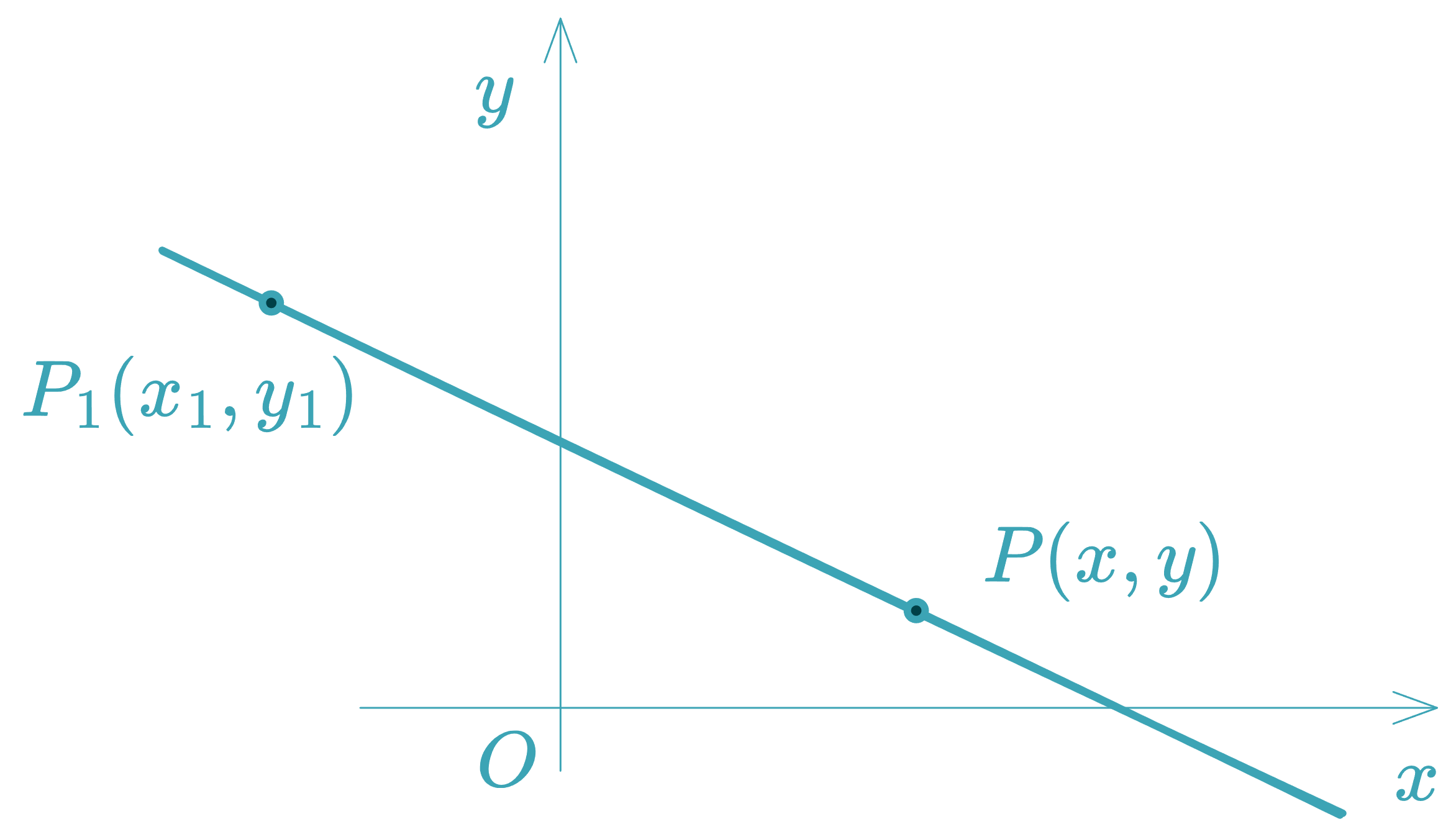
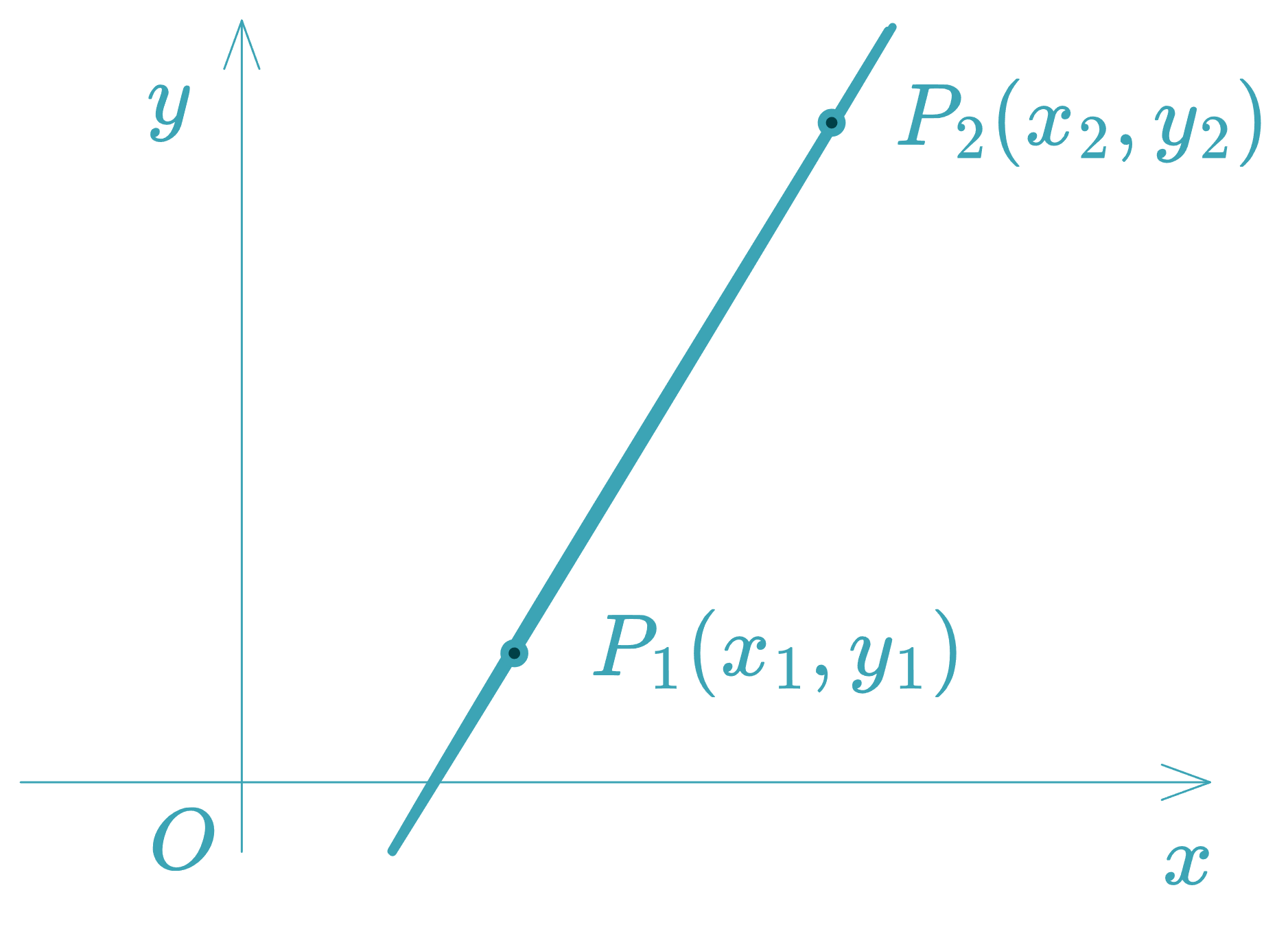
Two-Point Form (Cartesian Form)
Given two distinct points and , with :
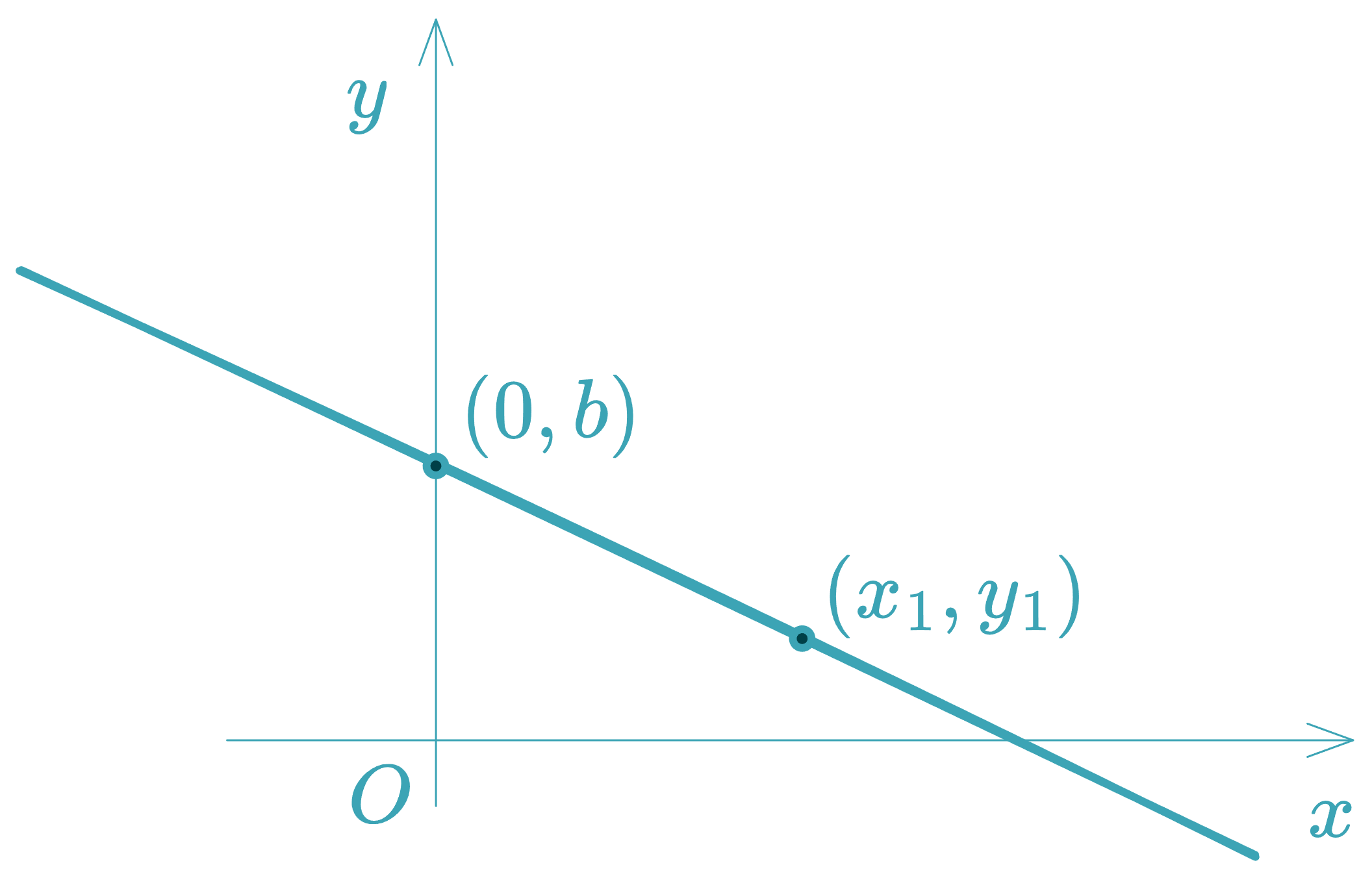
Slope–Intercept Form
Given slope and -intercept (the point where the line crosses the -axis):
Where:
- : slope
- : -intercept
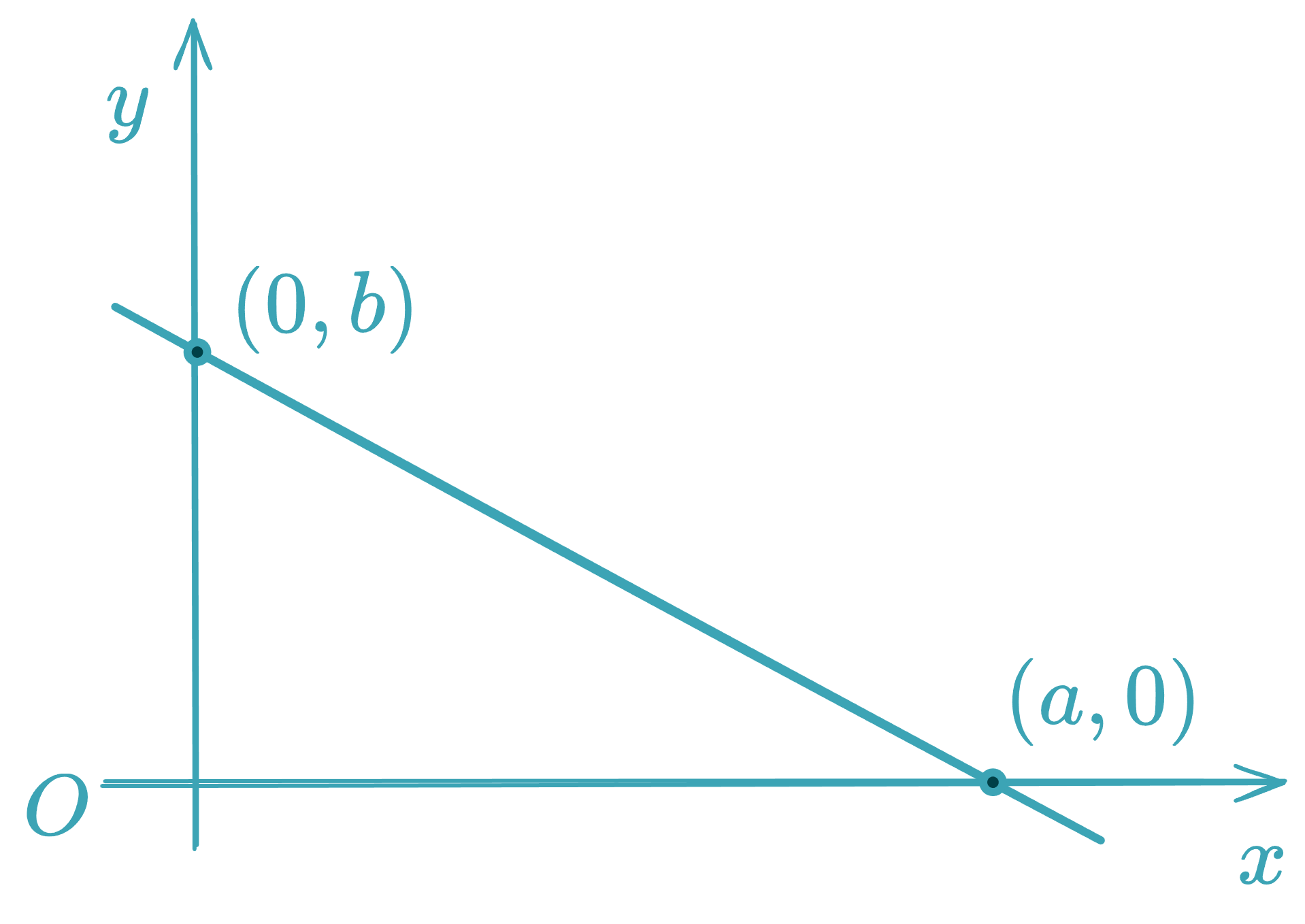
Intercept Form (Symmetric Form)
If the line intersects the -axis at and the -axis at , with and :
Where:
- : -intercept
- : -intercept
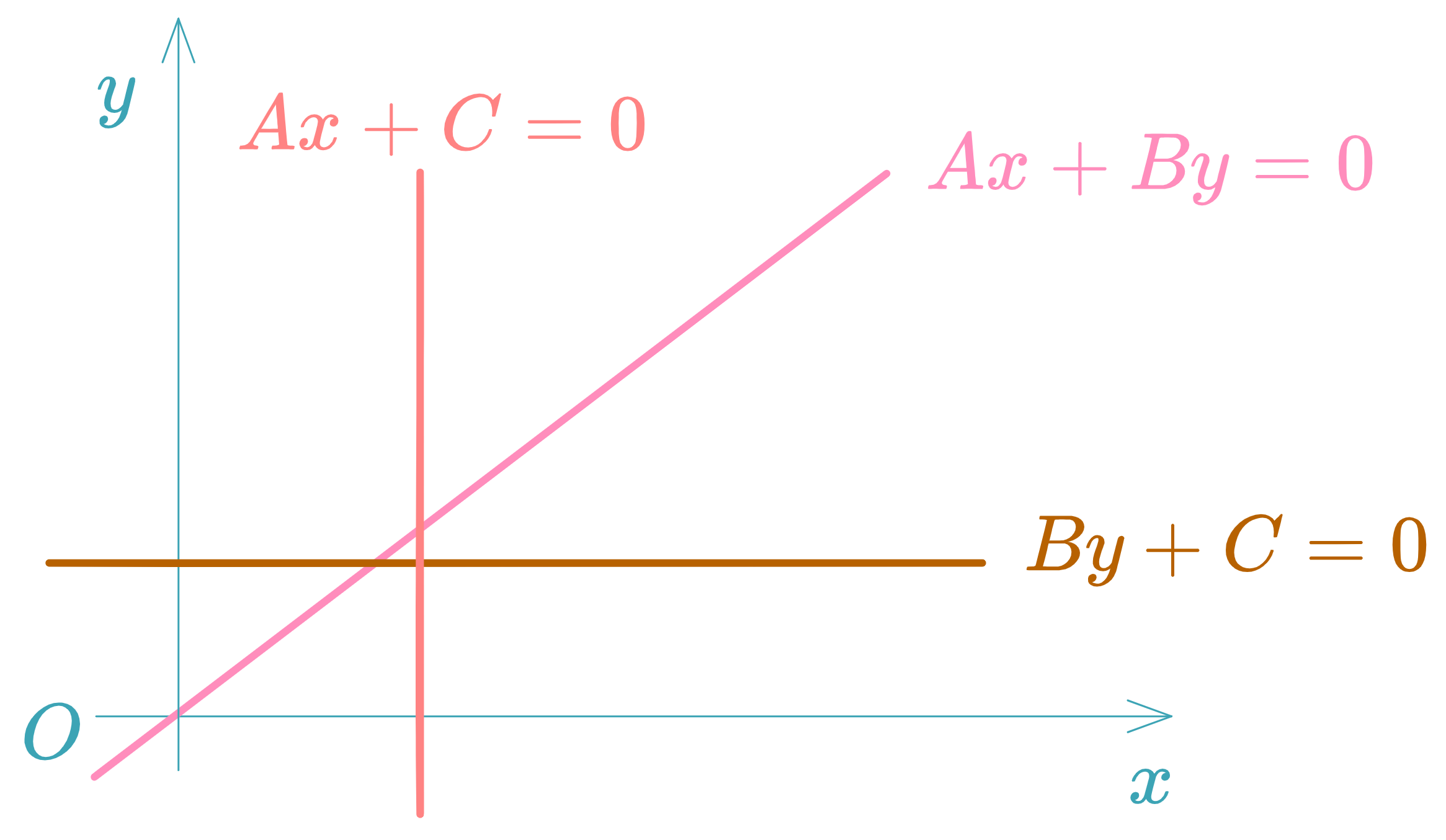
General Form of the Equation of a Line
Any straight line can be written as:
where , and not all are zero.
Special Cases:
1. If $A = 0$, $B \ne 0$, $C \ne 0$:
   $\Rightarrow y = -\dfrac{C}{B}$ → **horizontal line** (parallel to the $x$-axis).
2. If $B = 0$, $A \ne 0$, $C \ne 0$:
   $\Rightarrow x = -\dfrac{C}{A}$ → **vertical line** (parallel to the $y$-axis).
3. If $A \ne 0$, $B \ne 0$:
   $\Rightarrow y = -\dfrac{A}{B}x - \dfrac{C}{B}$ → slope–intercept form, with slope $m = -\dfrac{A}{B}$.
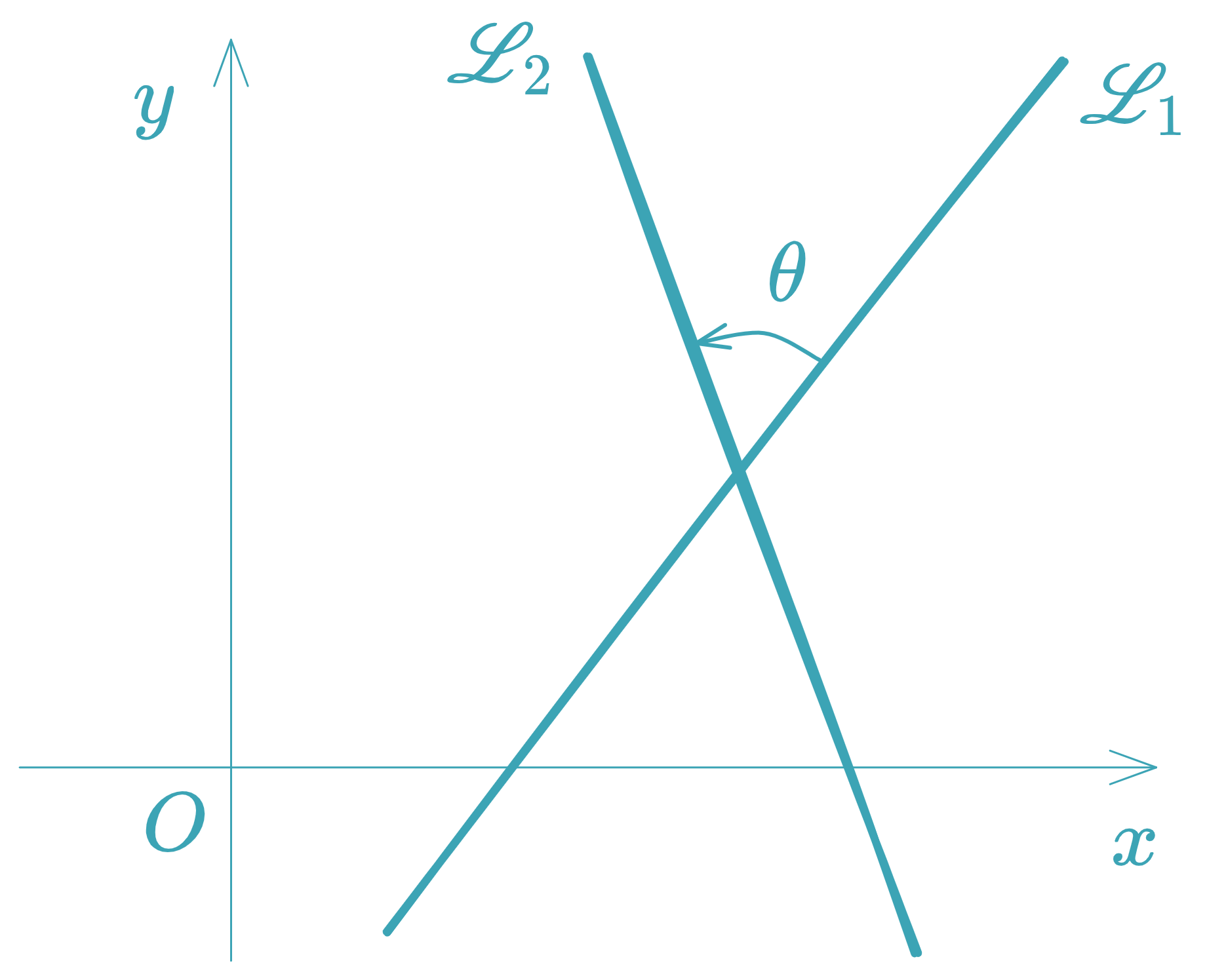
Angle Between Two Lines
Given two lines with slopes and , the acute angle between them is:
title: Note:
This formula gives the **acute angle** between the lines. For the obtuse angle, use $180^\circ - \theta$.
Relative Positions of Two Lines
Consider the lines:
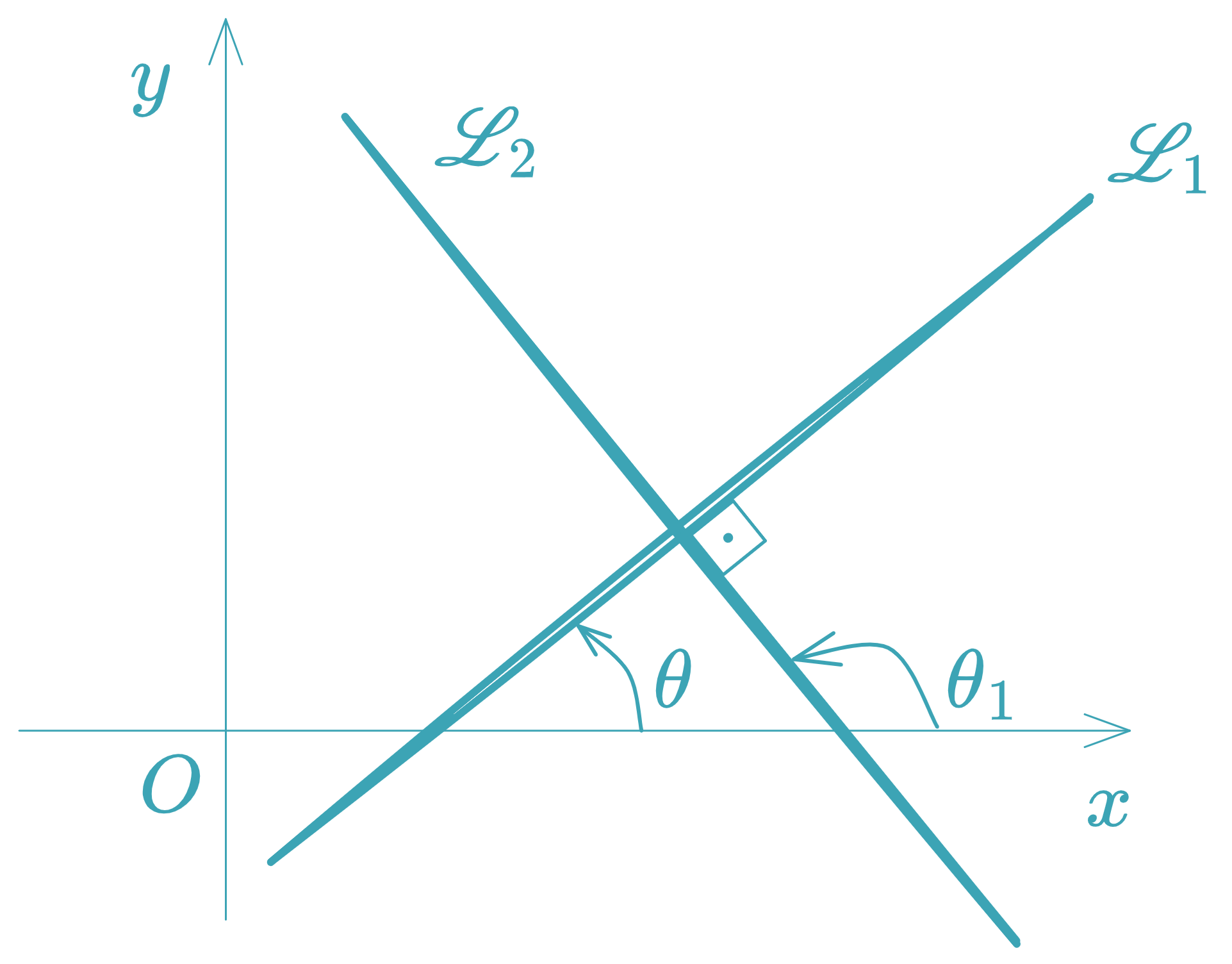
Perpendicular Lines
Two lines are perpendicular if their slopes satisfy . In terms of coefficients:
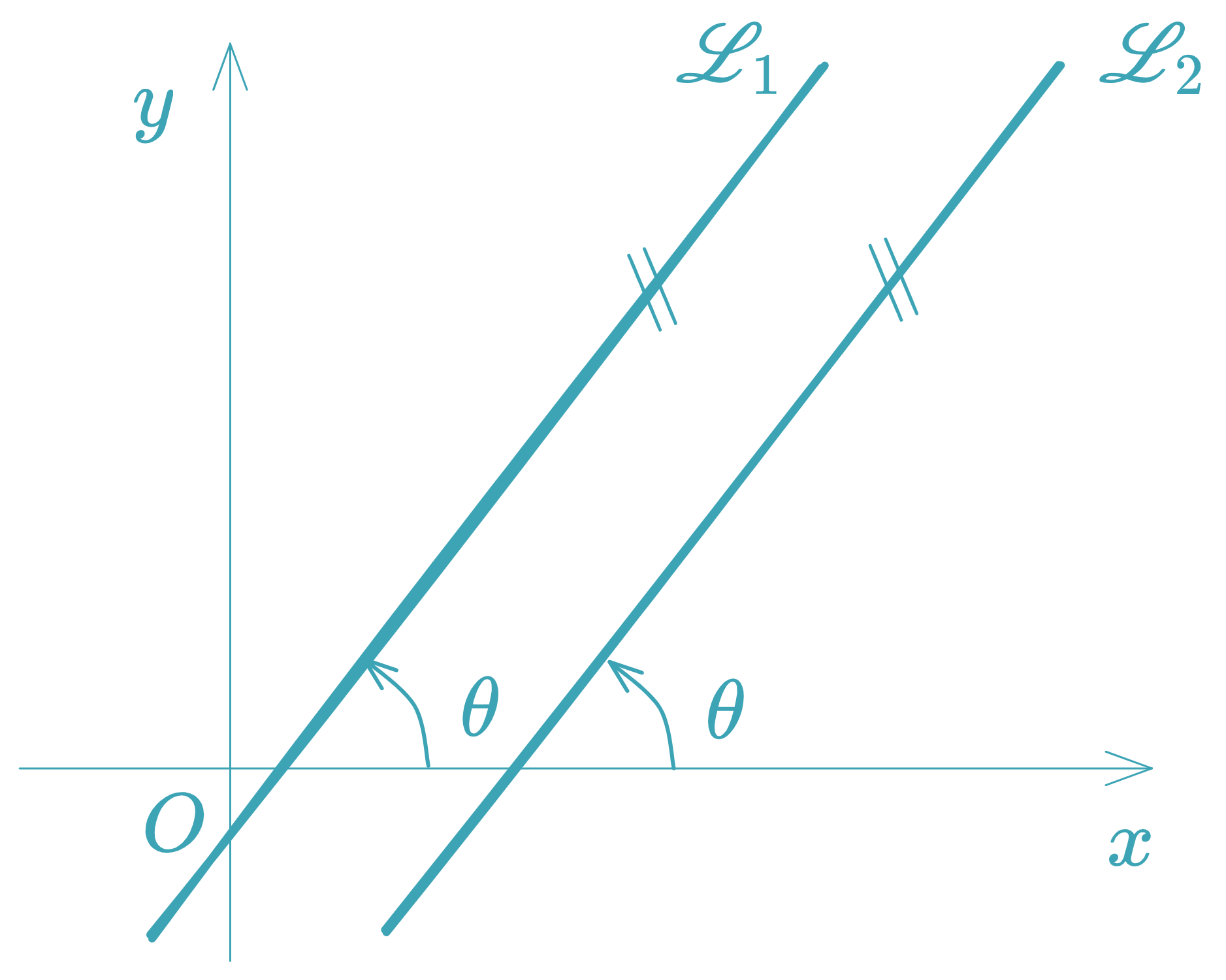
Parallel Lines
Two lines are parallel if they have equal slopes:
title: Note:
If, in addition, $\dfrac{C_1}{C_2} = \dfrac{A_1}{A_2}$, then the lines are **coincident**.
Coincident Lines
Two lines are coincident if all their coefficients are proportional:
Oblique (Intersecting) Lines
Two lines intersect at exactly one point if they are not parallel:
Normal Form of the Equation of a Line
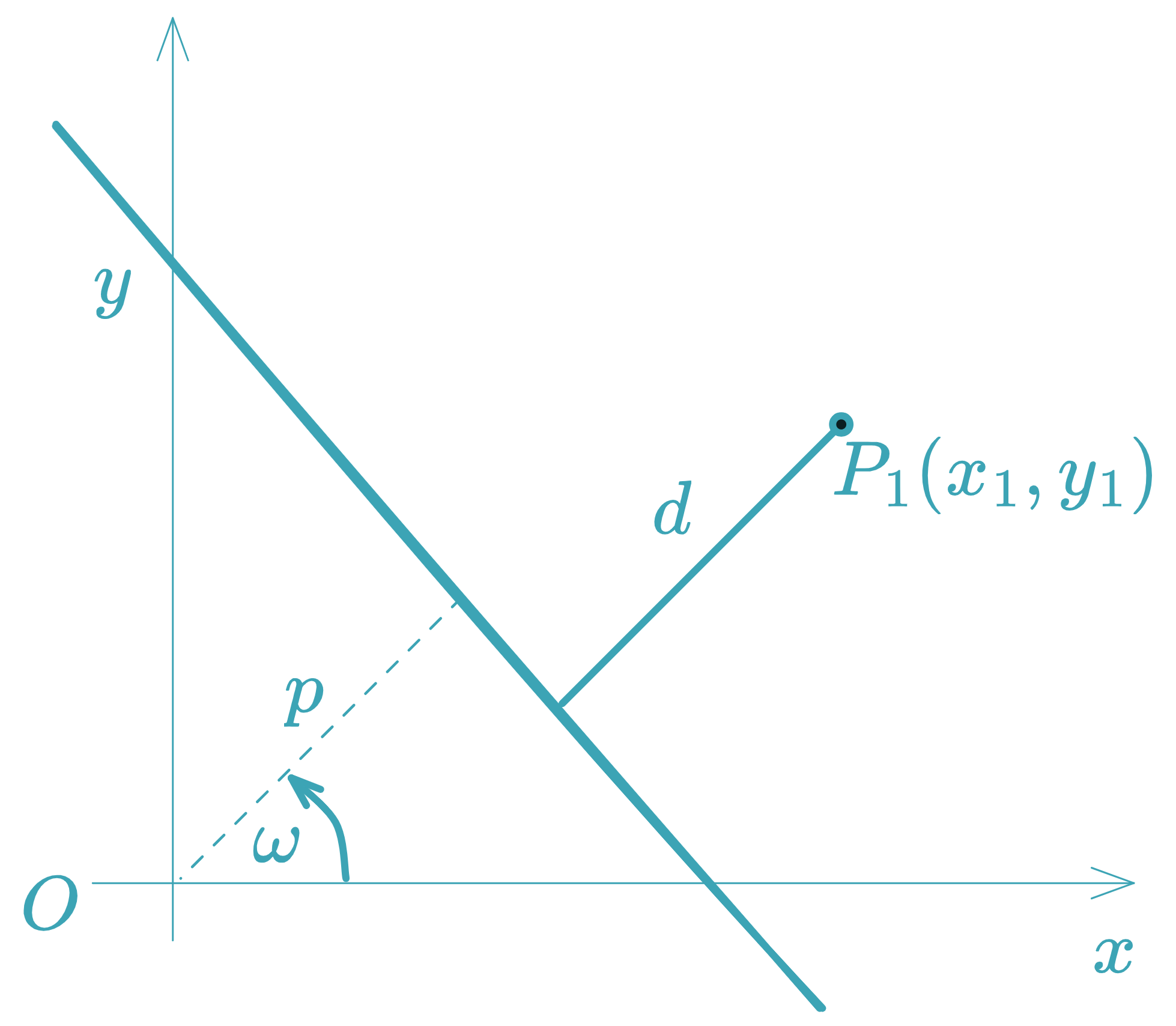
The normal form of a line is:
Where:
- : angle between the normal vector and the positive -axis ()
- : perpendicular distance from the origin to the line (always )
Converting General Form to Normal Form
Given , divide by , choosing the sign opposite to that of to ensure :
The sign is chosen so that , which guarantees .
Applications of the Normal Form
Distance from a Point to a Line (Absolute Distance)
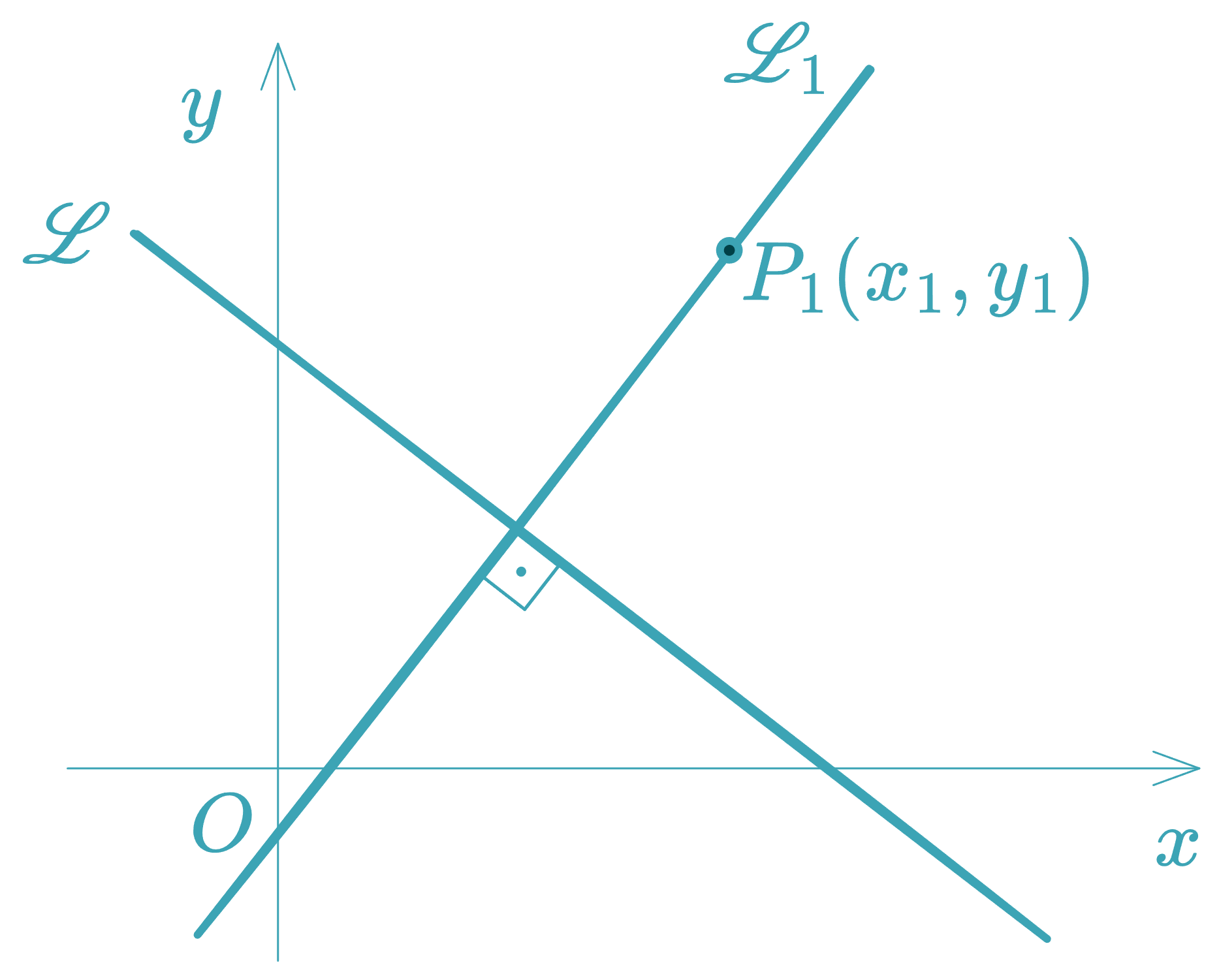
Given a point and a line , the (always non-negative) perpendicular distance is:
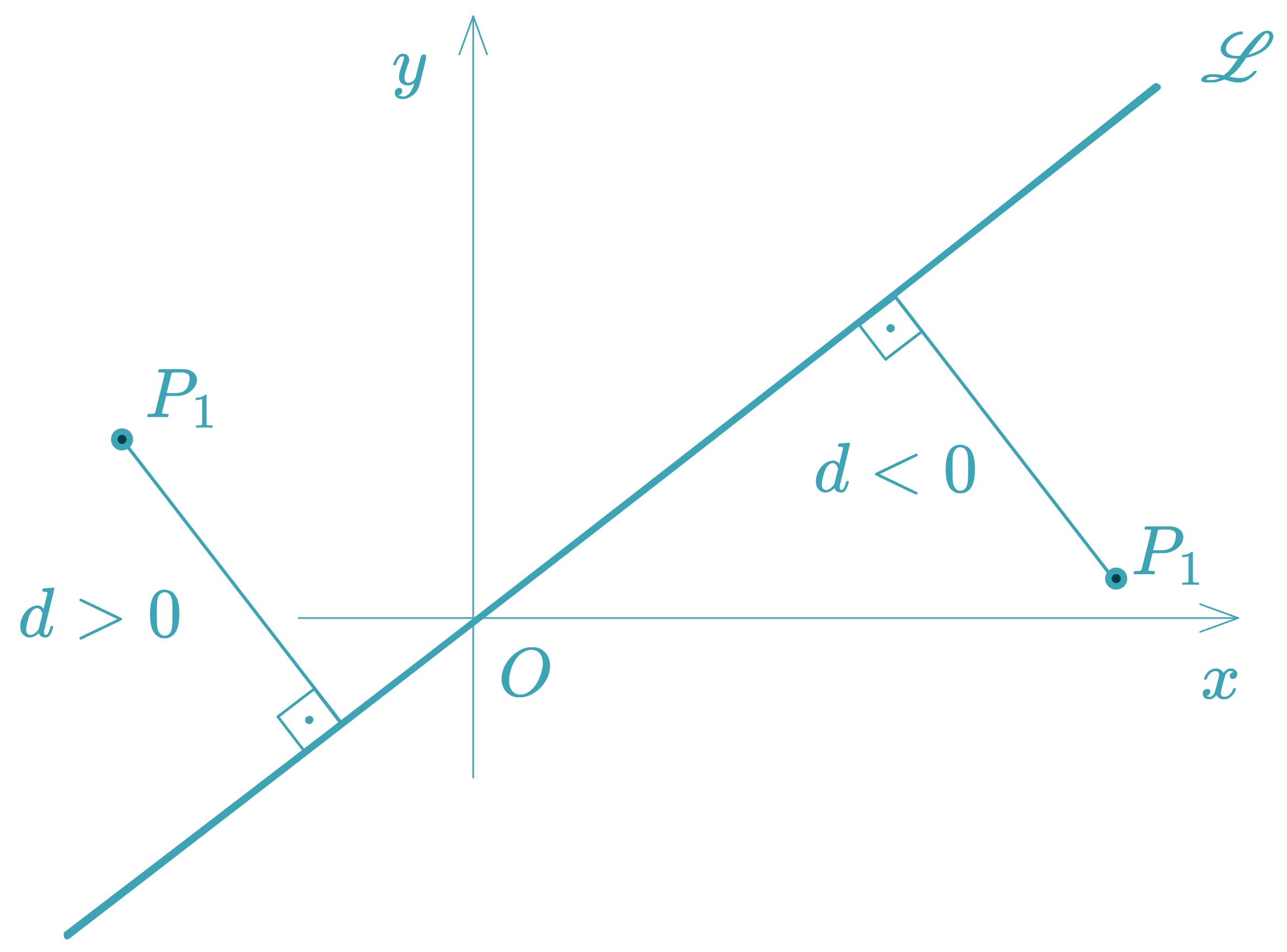
Directed Distance from a Point to a Line
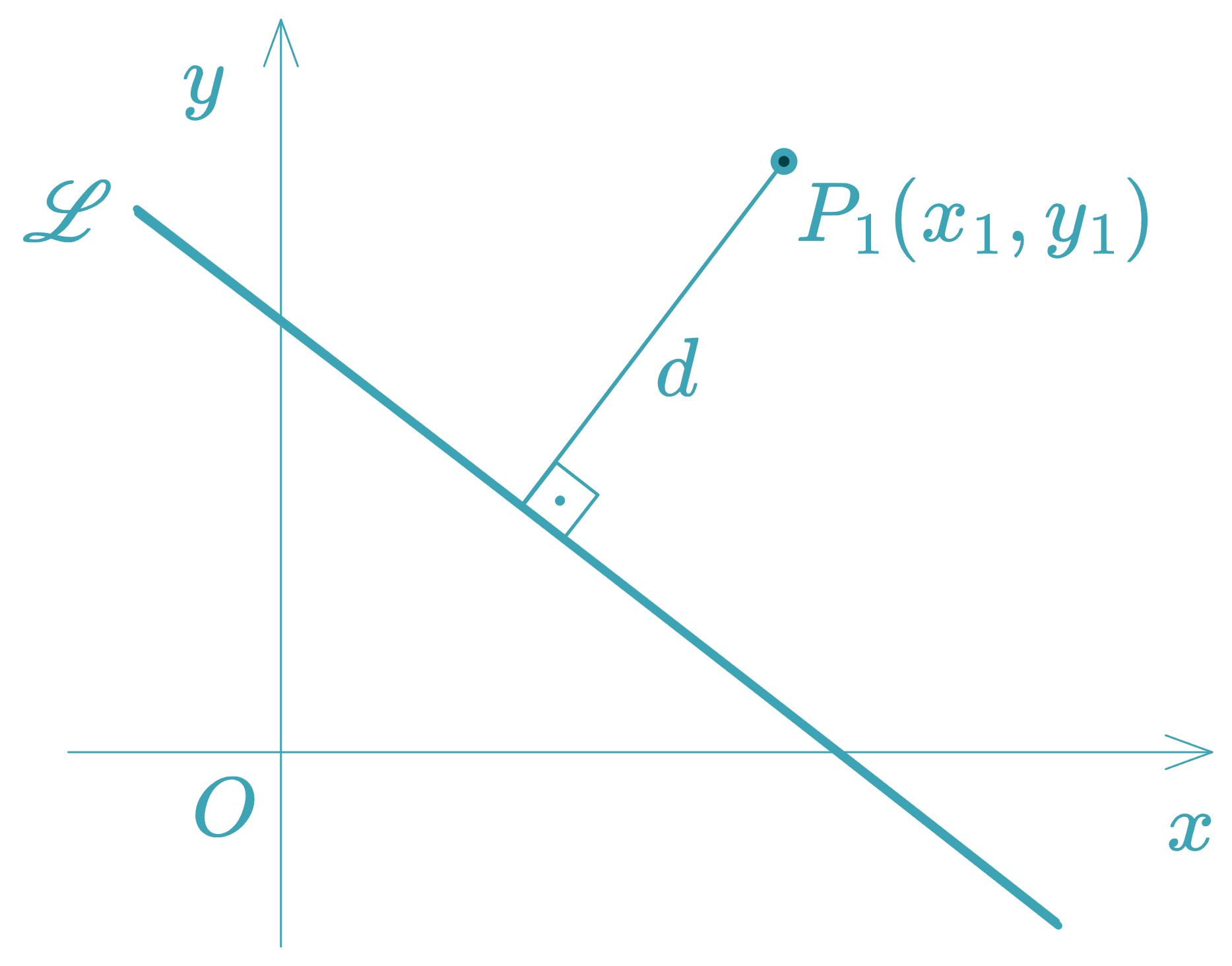
The directed distance carries a sign that depends on the orientation of the normal vector :
title: Important
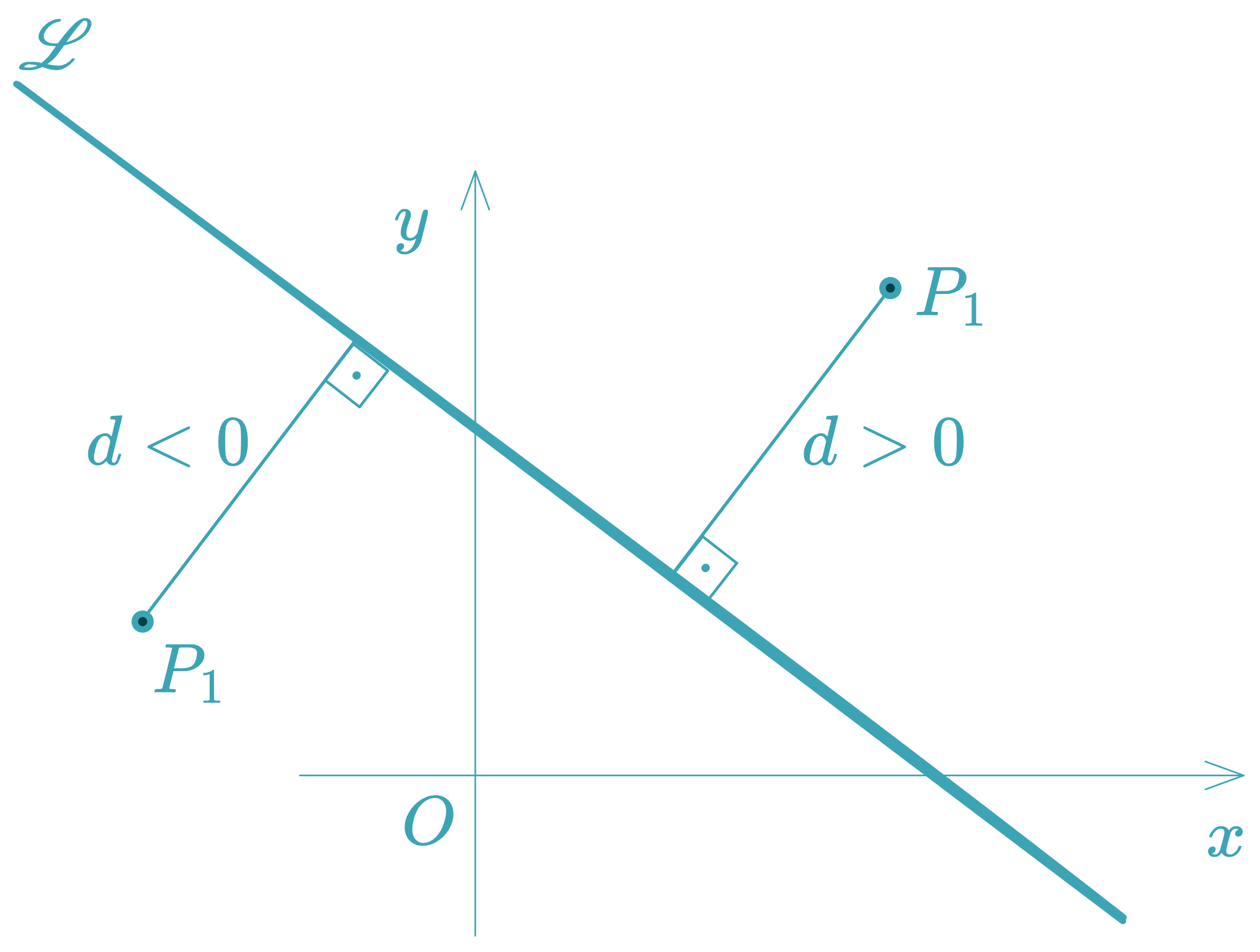
The denominator is always positive. The sign of $d$ depends on the numerator and reflects the point’s position relative to the **normal vector** $(A, B)$:
- If $d > 0$: the point lies in the direction of the normal vector.
- If $d < 0$: the point lies in the opposite direction.
Special Cases:
-
Line not passing through the origin ():
- if and the origin lie on opposite sides of the line.
- if they lie on the same side.
-
Line passing through the origin ():
- if is "above" the line (in the direction of ).
- if it is "below".
title: Note:
The sign of the directed distance is determined **only by the numerator**. Do **not** include $\pm$ in the denominator—modern convention fixes the denominator as **positive**.
Angle Bisectors of Two Intersecting Lines
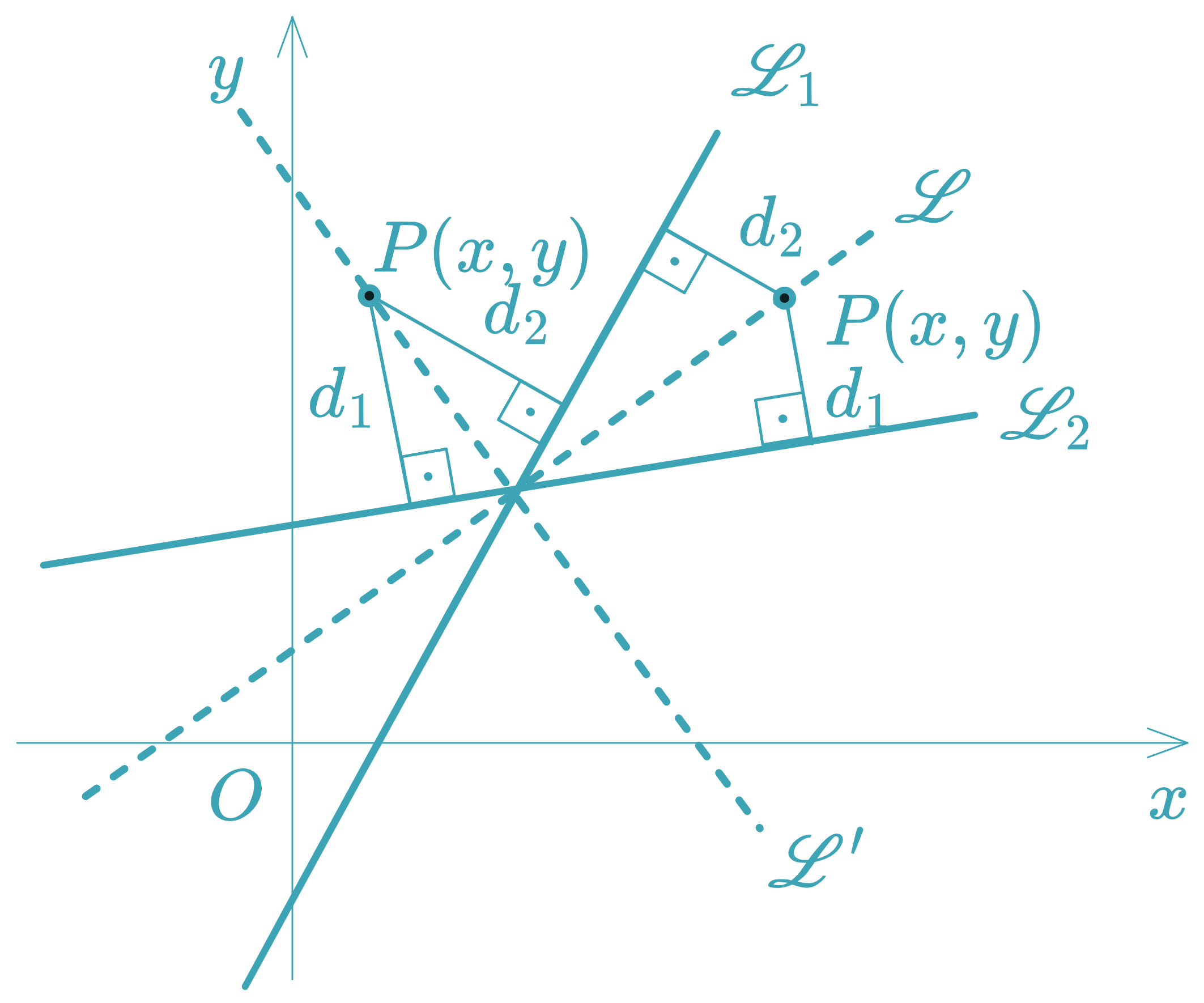
Given two lines and , the angle bisectors are the loci of points equidistant to both lines:
Removing absolute values gives the two bisectors:
- Use **+** for the bisector of the angle containing the direction of the sum of unit normals (often the **acute** angle).
- Use **–** for the **obtuse** angle bisector.
Distance Between Two Parallel Lines
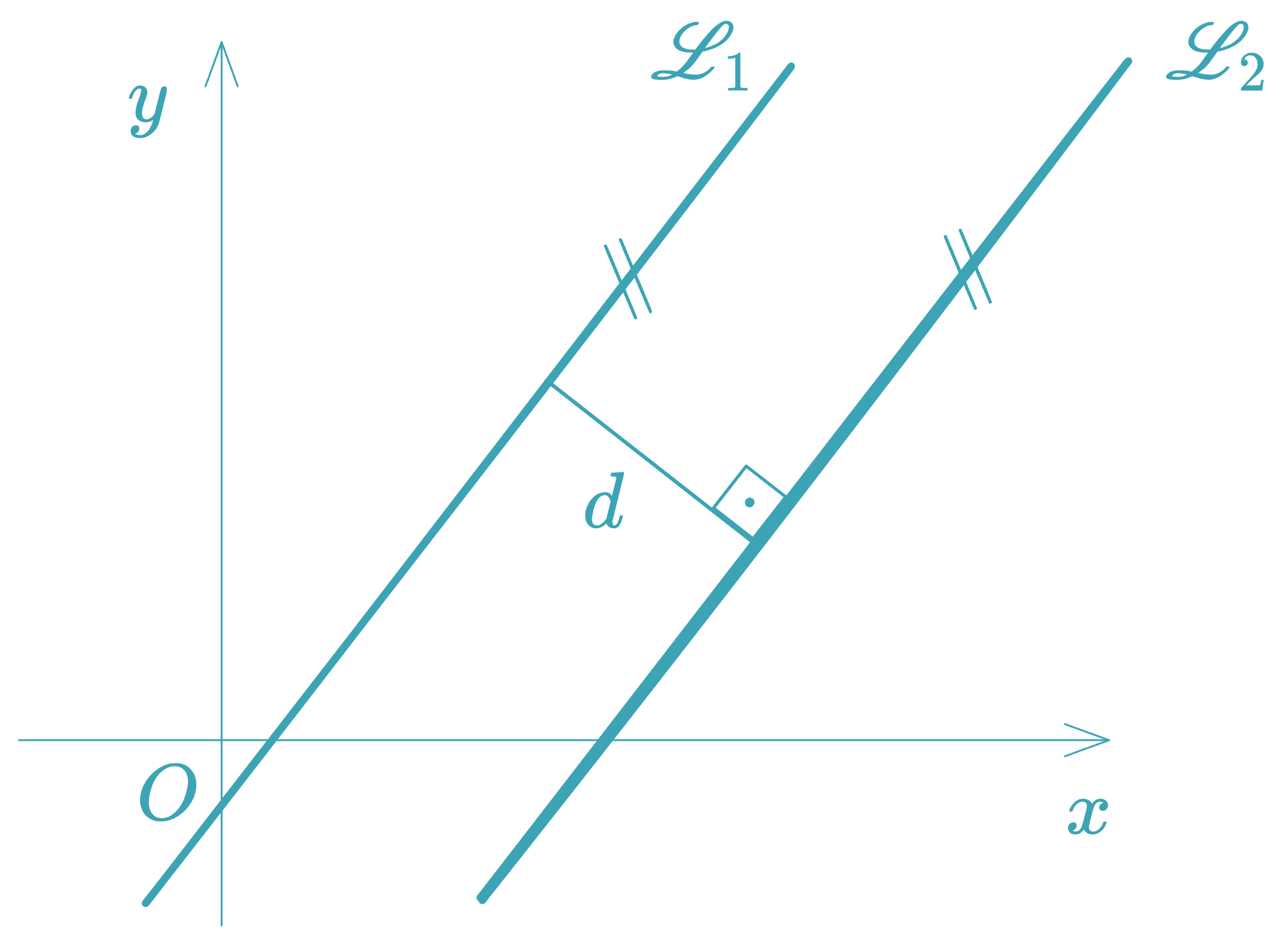
Given two parallel lines and (same and ), the distance between them is:
title: Note:
The formulas assume both equations use **identical coefficients** $A$ and $B$.
Area of a Triangle
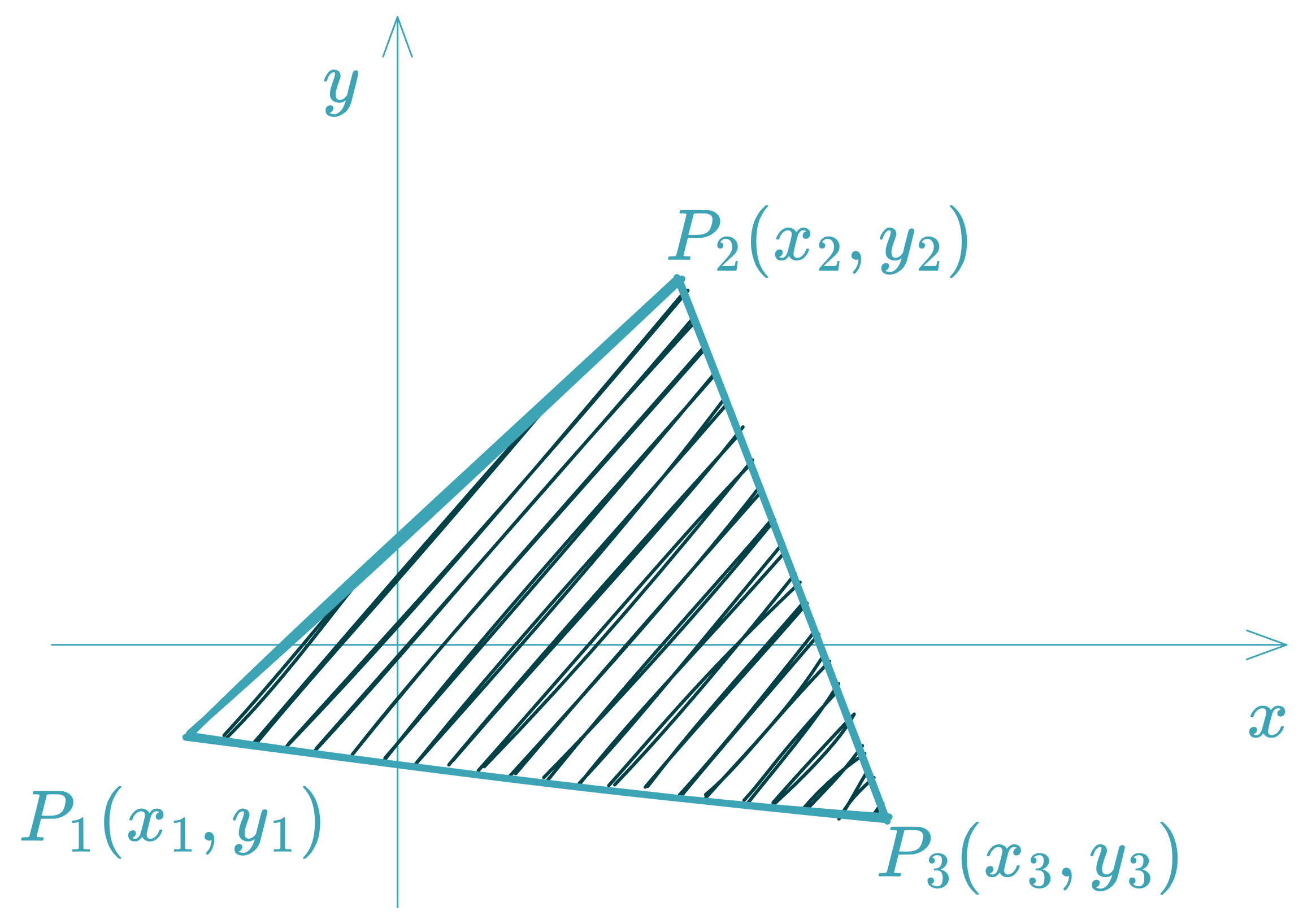
Given three vertices , , , the area of the triangle is:
Or using a determinant:
Determinant Form of the Line Through Two Points
Given and , the equation of the line is:
Families of Lines
Family of Lines Parallel to a Given Line
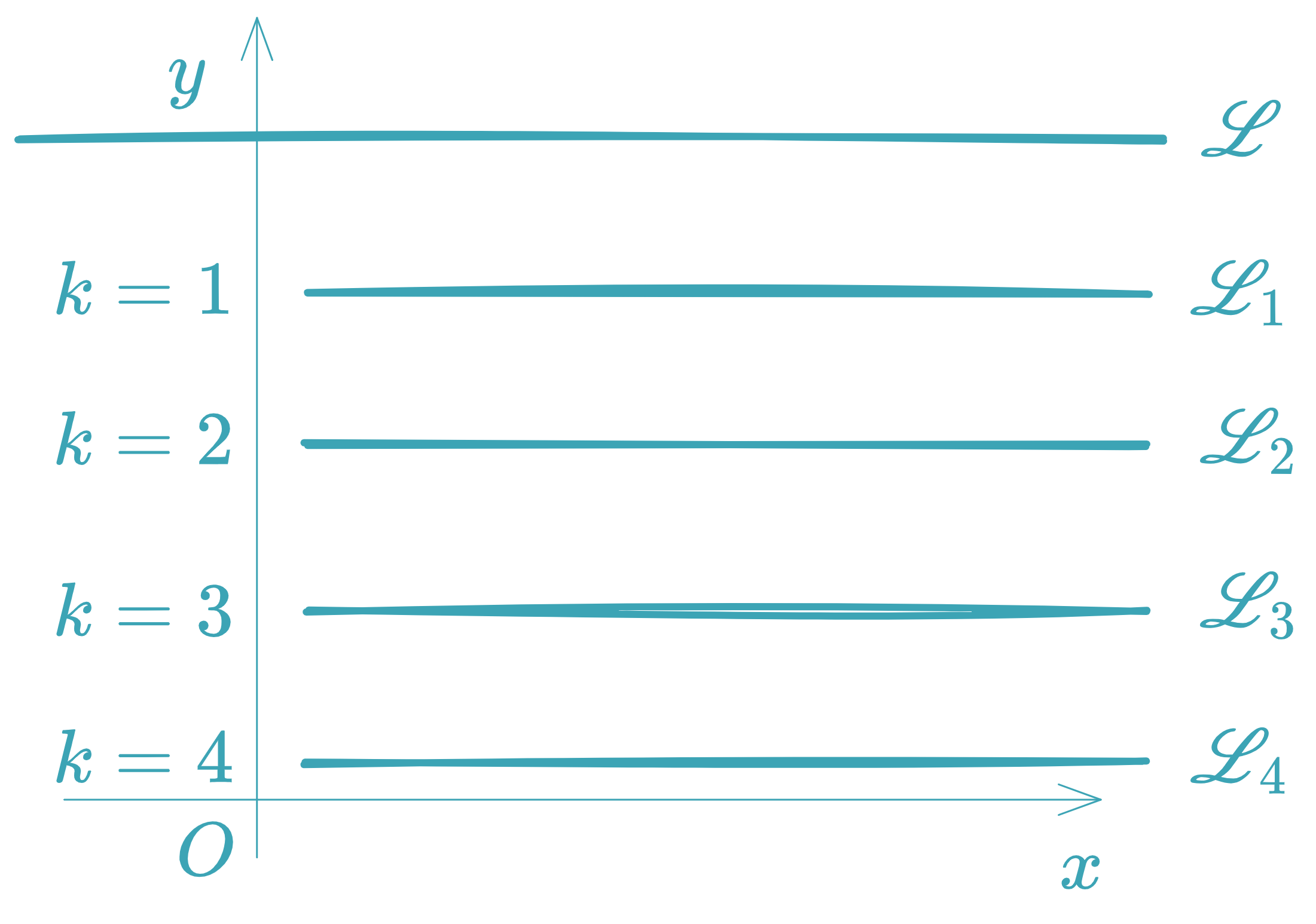
Given , the family of parallel lines is:
Family of Lines Perpendicular to a Given Line
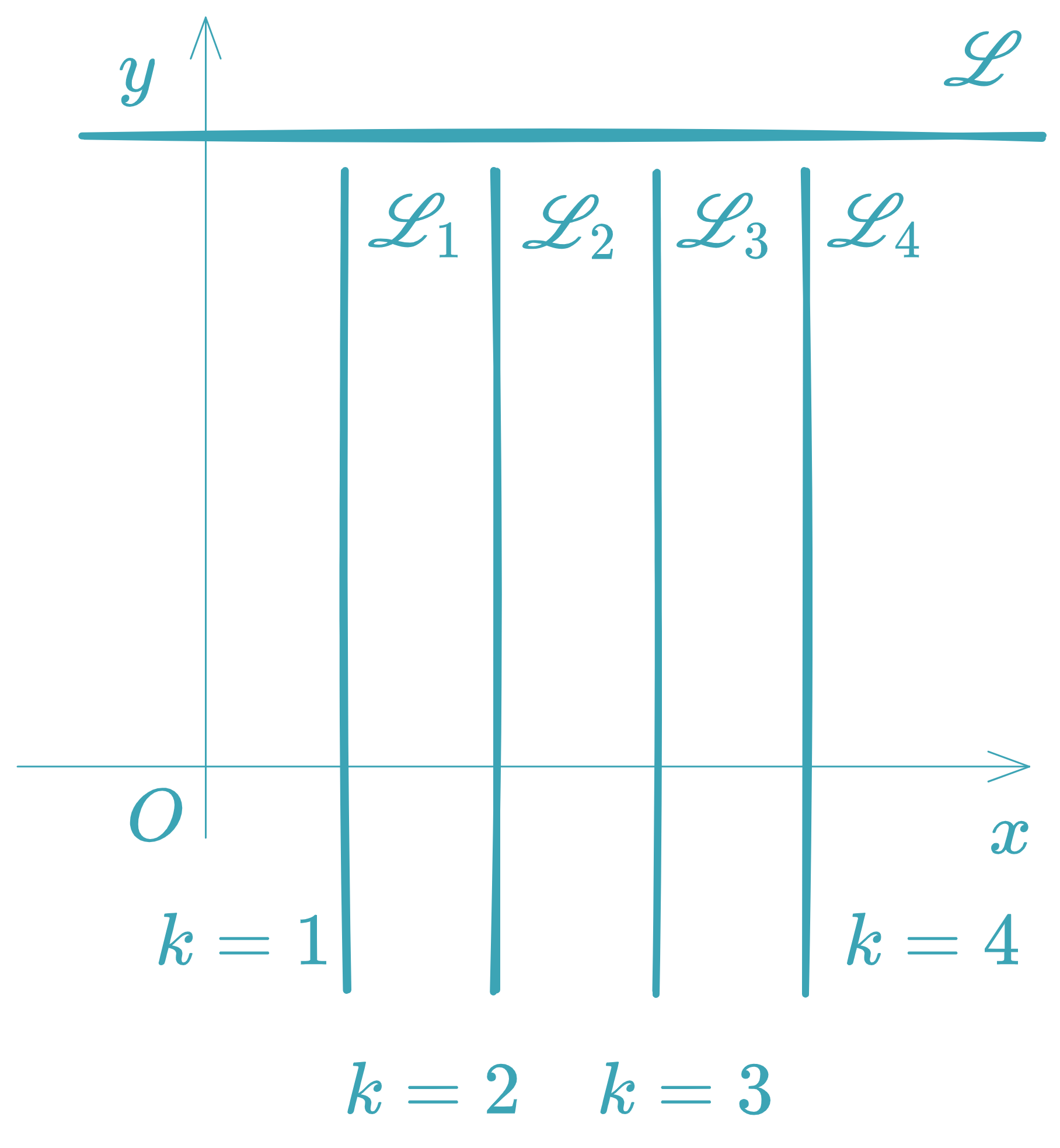
If a given line has slope , all perpendicular lines have slope . If they pass through a fixed point :
In general form: if the original line is $Ax + By + C = 0$, then all perpendicular lines have the form $Bx - Ay + k = 0$.
Family of Lines Concurrent at a Point
Given two intersecting lines and , the family of all lines passing through their intersection point is:
title: Note:
The value $\lambda = -1$ may correspond to a line at infinity or a degenerate case, depending on the context.